Case Management: From Initiation to Resolution — One Intelligent Platform.
| Table of Contents |
|---|
| 1. Abstract |
| 2. Introduction |
| 3. Overview of the Case |
| 3.1 Case Dashboard |
| 3.2 Case Record |
| 3.3 Case Log |
| 3.4 Case Summary |
| 3.5 Component Interaction Model |
| 3.6 Case Lifecycle and Data Flow |
| 4. Conclusion |
Abstract
A digital case-management system requires a structured information model to manage the complete lifecycle of a case and maintain relationships between case metadata, participants, workflow states, events, documents, submissions, activities, and outcomes. A case-management architecture must provide mechanisms to create and maintain case entities, track workflow progression, manage associated records, record system activities, and expose relevant information through appropriate interfaces. This article describes the functional architecture of case management in Jupitice through five core components: Case, Case Dashboard, Case Record, Case Log, and Case Summary. Each component represents a distinct information or functional layer within the case lifecycle. The Case acts as the primary entity and reference context; the Case Dashboard provides a state-oriented interface for accessing operational data; the Case Record manages case-associated documents and evidence; the Case Log maintains chronological activity data; and the Case Summary provides a consolidated representation of key case information. The separation of these components establishes a structured approach to data organization, workflow management, document handling, activity traceability, information retrieval, and case lifecycle management.
Keywords
Case Management, Legal Technology, System Architecture, Case Entity, Workflow Management, Case Dashboard, Case Record, Case Log, Case Summary, Metadata Management, Document Management, Activity Tracking, Audit Trail, Information Model, Case Lifecycle.
Introduction
A digital case-management platform must manage multiple categories of information that are generated and modified throughout the lifecycle of a legal matter. These include case metadata, participant information, workflow states, events, hearings, documents, submissions, system activities, decisions, and other case-related records. As a case progresses, information is generated by different users and system processes. The platform therefore requires a defined structure for associating these records with the appropriate case while maintaining data consistency, traceability, accessibility, and authorization boundaries. From a technical perspective, case management can be represented as a lifecycle-driven information model in which the Case functions as the primary entity and related components operate as specialized data and presentation layers. The Case Dashboard exposes operational information, the Case Record manages associated documentary data, the Case Log maintains activity history, and the Case Summary provides a consolidated representation of relevant case information. This separation enables the platform to process and present case information according to its functional purpose while maintaining the relationship between all records associated with the same case.
Overview of the Case
The Case is the primary entity within the case-management system. It represents a legal matter, dispute, proceeding, or other case instance and provides the reference context for all associated entities and activities. A Case can contain core metadata such as a unique Case ID, case type, submission information, participants, status, workflow configuration, timestamps, scheduled activities, and resolution information. Related entities such as documents, events, submissions, hearings, and activities are associated with the Case through their respective relationships. The Case entity acts as the root context for lifecycle management. Its state can change as workflow activities are completed, participants are added, events occur, documents are submitted, and decisions are recorded. Within Jupitice, authorized users can create or host cases, configure or participate in case workflows, add participants, submit documents, conduct hearings, manage case activities, and track the progression of the matter. Where an investigation forms part of the case workflow, investigation-related information can be associated with the Case. This may include evidence, findings, observations, recommendations, and other relevant records, subject to applicable authorization and workflow rules. The Case therefore provides the primary association point through which the platform manages the complete lifecycle of the matter.
Case Dashboard
The Case Dashboard is the presentation and interaction layer used to expose the operational state of a Case. It retrieves and presents relevant case attributes and associated activity information through a consolidated interface. The dashboard can display case metadata, including the Case ID, case type, submitting party, submission date, current status, workflow stages, and stage completion. It can also expose information related to participants, case members, hearings, proceedings, deadlines, scheduled events, documents, submissions, notifications, and recent updates. The dashboard does not represent the underlying documentary or activity data independently. Instead, it provides an interface through which users can access and interact with information maintained by the corresponding case components. Case retrieval can be supported through configurable sorting and filtering parameters such as priority, location, program, question, status, and other applicable attributes. These mechanisms allow the system to narrow the displayed case set according to defined criteria. From an architectural perspective, the Case Dashboard primarily functions as the operational presentation layer for case state and related information.
Case Record
The Case Record represents the document and evidence layer associated with a Case. It maintains the materials generated, uploaded, submitted, exchanged, or issued during the case lifecycle. The repository can contain pleadings, notices, summons, evidence, written submissions, arguments, interim orders, procedural orders, correspondence, supporting documents, judgments, decisions, and other case-related materials. Where proceedings are recorded, corresponding recordings can also be associated with the Case Record. Each document or material is maintained within the context of its associated Case, allowing authorized users to retrieve relevant information without relying on external or disconnected repositories. From a technical perspective, the Case Record is responsible for the organization and retrieval of case-associated documentary data. Access to these materials can be governed through the platform’s applicable user roles, permissions, and case-level authorization mechanisms. The Case Record therefore represents the document-management and evidence layer of the case-management architecture.
Case Log
The Case Log represents the activity-tracking layer of the case-management system. It maintains a chronological sequence of significant actions and events associated with a Case. Log entries can be generated for activities such as case creation, case initiation, participant additions, event creation, event initiation, submissions, and other significant case operations. An activity record can contain contextual information such as the timestamp of the activity, action type, initiating user or actor, associated participants, comments, and references to the related case activity. The chronological structure of the Case Log allows the system to maintain historical context independently of the current Case state. For example, while the Case may currently have a particular status, the Case Log can provide the sequence of activities that resulted in that state. The Case Log therefore functions as the activity history and traceability layer, supporting historical analysis, operational accountability, and audit-oriented review of case activities.
Case Summary
The Case Summary is a consolidated information layer that represents the key substantive attributes and developments associated with a Case. It can include information relating to the parties, case background, key facts, significant dates, major events, current stage, issues under consideration, decisions, rulings, current status, and final outcome where applicable. The summary is intended to provide a compact representation of the Case without requiring users to process the complete set of associated documents or historical activities. From a technical perspective, the Case Summary can be viewed as a derived or consolidated representation of relevant case information, presenting selected attributes and developments in a format suitable for rapid review. The Case Summary therefore focuses on the substantive context of the Case rather than the detailed operational state presented by the Dashboard or the individual records maintained within the Case Record and Case Log.
Component Interaction Model
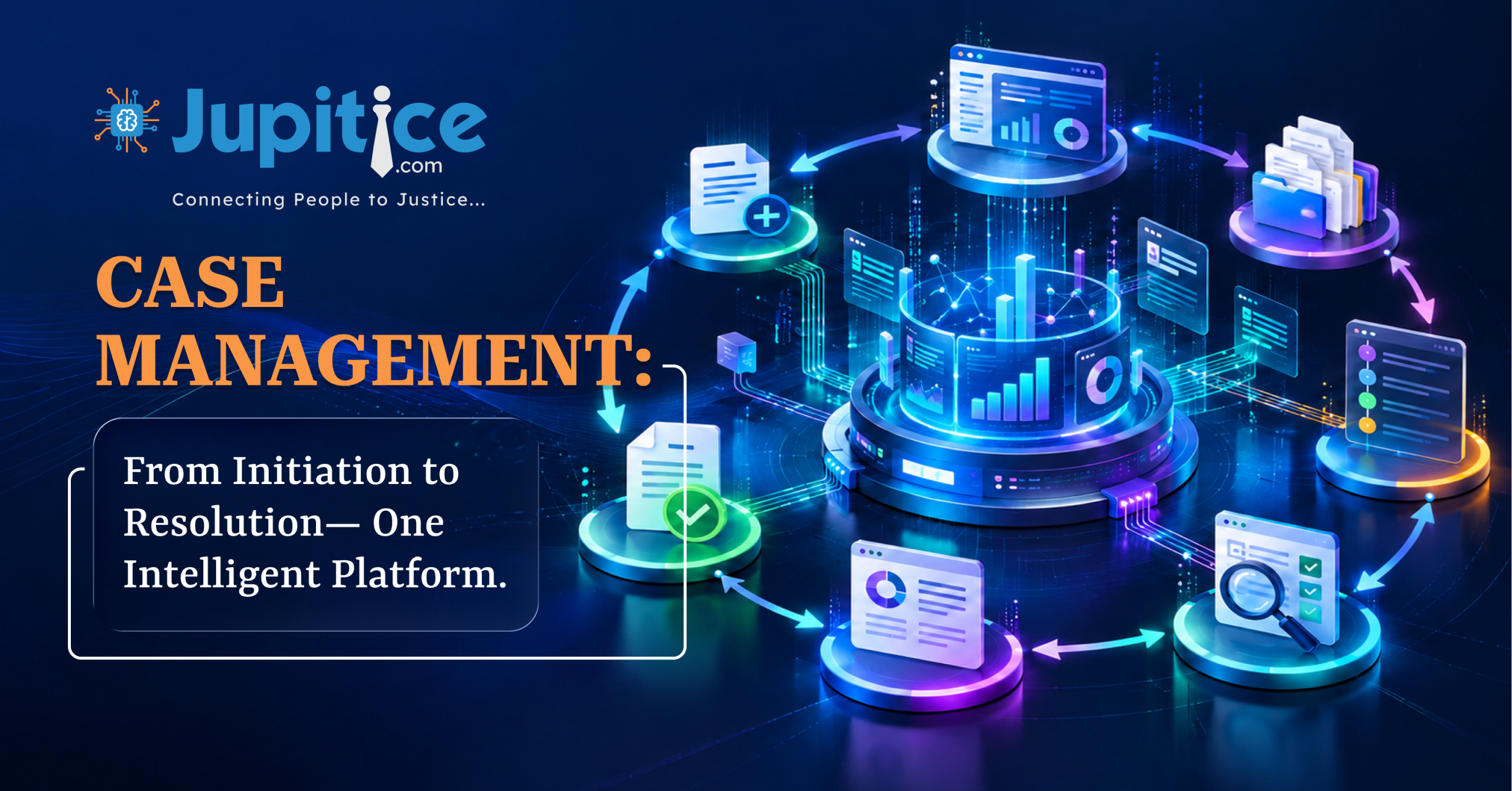
The Case Management architecture consists of interconnected functional components operating around the primary Case entity. The Case provides the primary reference context. The Case Dashboard consumes relevant case-state and associated information to provide an operational interface. The Case Record maintains documentary and evidentiary data associated with the Case. The Case Log stores chronological activity information generated throughout the lifecycle. The Case Summary consolidates selected case information into a concise representation.
Conceptually, the relationship can be represented as:
- Case Entity → Operational View + Document Layer + Activity Layer + Summary Layer
- The operational view is represented by the Dashboard, the document layer by the Case Record, the activity layer by the Case Log, and the consolidated information layer by the Case Summary.
- This separation establishes clear functional boundaries between current state, source data, historical activity, and summarized information while preserving their association with the same Case entity.
Case Lifecycle and Data Flow
The case lifecycle begins when a Case entity is created and initialized with its applicable metadata, participants, and workflow configuration. As the case enters processing, users and system workflows generate events, submissions, documents, and other associated records. As workflow activities occur, the Case state can be updated according to the configured lifecycle. The Case Dashboard retrieves the relevant state and associated information for operational presentation, while documents and supporting materials are persisted within the Case Record. Significant user and system actions are captured within the Case Log, creating a chronological activity trail. Case information can subsequently be consolidated into the Case Summary to provide a concise representation of the matter’s substantive context and current position. During resolution, decisions, judgments, or other outcome-related information can be associated with the Case and its corresponding records. Following closure, the Case maintains its associated metadata, documentary records, activity history, and summary information as part of the complete lifecycle.
The resulting flow can be represented conceptually as:
Case Creation → Workflow Processing → Event & Document Generation → State Updates → Activity Logging → Review → Resolution → Case Closure
Conclusion
A digital case-management system requires a defined architecture for managing case entities and their associated information throughout the complete lifecycle of a legal matter. Separating operational data, documentary records, activity history, and summarized information allows each information category to be managed according to its specific functional requirements. Within Jupitice, the Case functions as the primary lifecycle entity and association context. The Case Dashboard provides the operational presentation layer for case state and related information. The Case Record provides the document and evidence layer, while the Case Log provides chronological activity tracking and traceability. The Case Summary provides a consolidated representation of the key substantive information associated with the Case. Together, these components establish a structured case-management model that supports entity management, workflow execution, state tracking, document management, activity traceability, information retrieval, access control, and lifecycle management. By maintaining clear functional boundaries while preserving relationships between the different information layers, the architecture provides a consistent technical foundation for managing a case from creation and workflow execution through documentation, activity tracking, review, resolution, and closure.